paper: pretty paper. true stories. {and scrapbooking classes with cupcakes.}

lovely to meet you Twitter Facebook Pinterest YouTube

Take a Scrapbooking Class

online scrapbooking classes

Shop Shimelle Products

scrapbook.com simon says stamp shimelle scrapbooking products @ amazon.com shimelle scrapbooking products @ amazon.co.uk

Reading Material

travel

Woodland Vintage Baby Shower (and scrapbook page)

woodland vintage baby shower and scrapbook page
woodland vintage baby shower
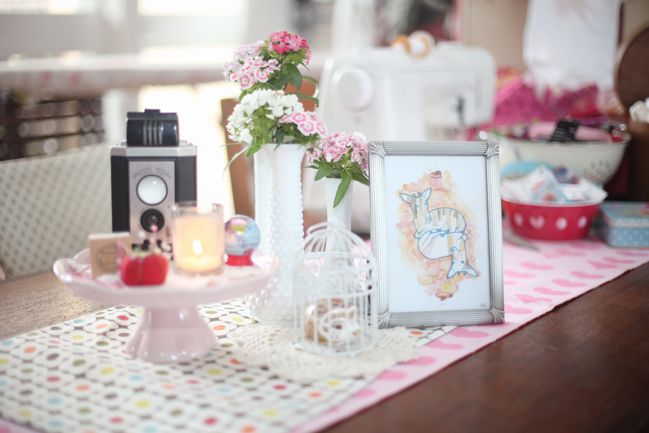
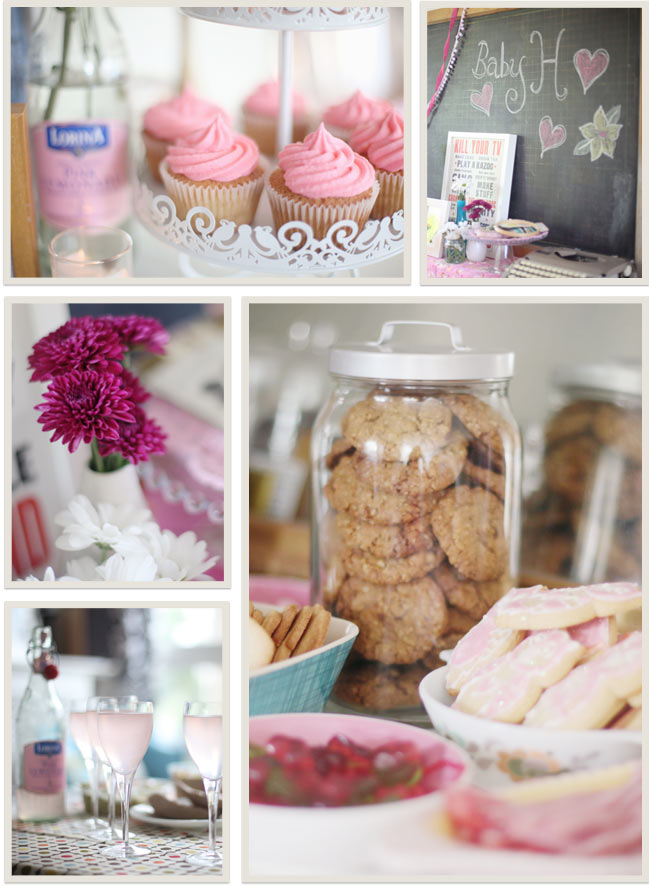
Any day now, this lovely friend of mine is going to Instagram from the hospital with a picture of a brand new baby girl, and although she wasn’t going to have a big party, I may have been quite excited at an excuse to cover my house in pink and throw the teeniest of baby showers.

woodland vintage baby shower decorations
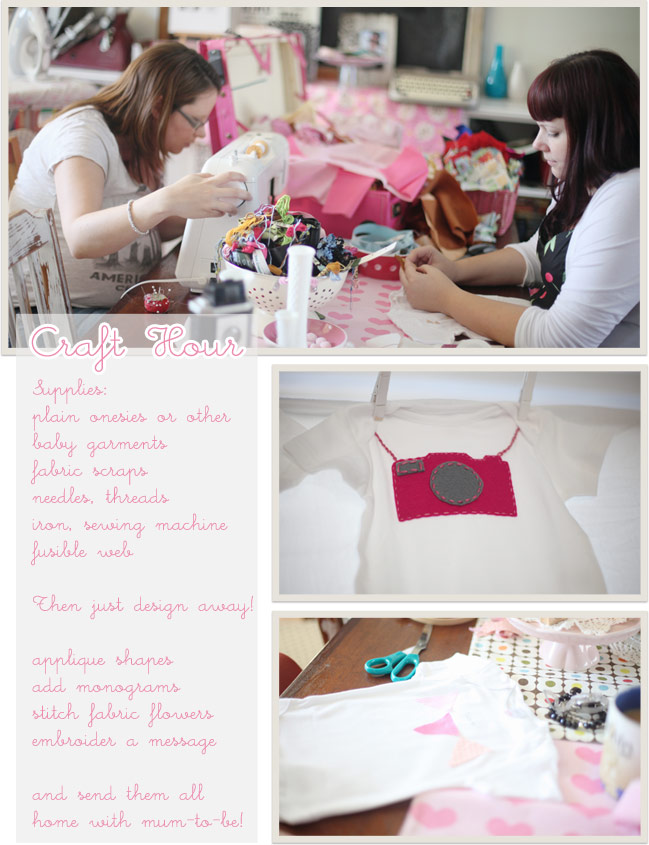
I think we managed to fool Laura (or at least she didn’t let on if she figured it out!) by inviting her for a day of lunch and photos and crafting with the girls, which isn’t an unheard of thing in our world. But usually when the girls arrive, there are not pink tissue-paper pom-pons hanging from the ceiling and a dozen types of pink sweets in bowls. So the four of us sipped pink lemonade and got crafty with a bit of baby wardrobe embellishing. Thanks so much to Leanne and SJ for your party-throwing and secret-keeping assistance!

diy custom onesies at baby shower
First of all, we always reserve the right to spend more than an hour on craft hour. We just like the name.

Second, a bit of DIY onesie creating is super easy and fun and it’s inexpensive enough that it doesn’t matter if something goes terrible wrong and you need to just bin one and start again. It’s actually best to find the bargain baby clothes because the more ‘named’ brands stitch logos on their baby clothes and seriously, does a newborn really need to be advertising for a giant chain? And if you or someone you know has a bit of a fabric scrap collection and they aren’t too precious about it, you can just work from that without needing to buy specific fabric. The clothes are tiny so most everything just takes small scraps of fabric. Cut things to whatever shape you want (and if you’re not a dab hand at drawing them, you can print out a variety of shape templates by searching for colouring book pages) and then either use fusible web to iron it to the onesie or you can sew it on by machine or by hand. Even with just four of us we had quite a mix of techniques, with an appliqued camera, a fabric-pieced fox, a monogram, fabric flowers and bunting. All very cute and in a variety of sizes so Baby H should be clothed in custom gear for quite a while!

baby shower scrapbook page

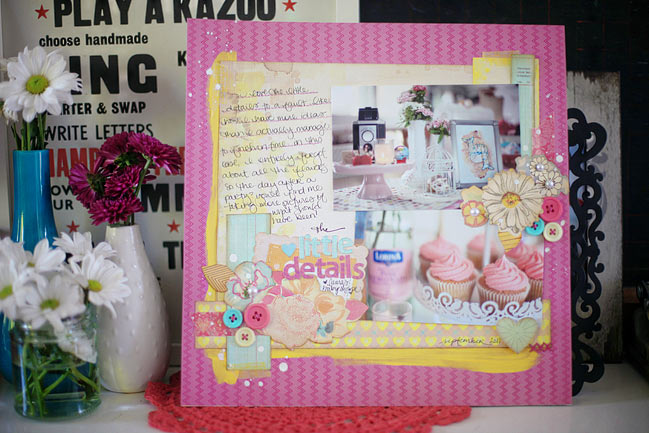
And of course all that photo-fun isn’t complete without lashings of pink patterned paper, pearls and paint. But mostly I wanted to share some pink cupcakes with on a Monday morning! Please enjoy one in your choice of vanilla or blackberry, and of course – completely carb- and calorie-free!

Have a beautiful week!

xlovesx

Scrapbooking Starting Point :: Our Autumn Escape

scrapbooking starting points - scrapbook page ideas
scrapbook page :: our autumn escape

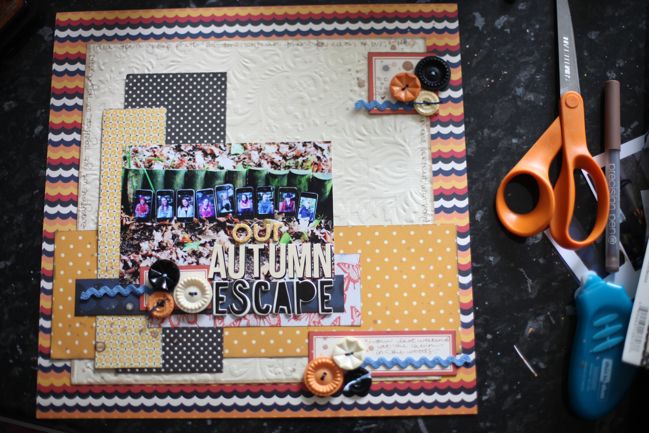
From this starting point came this page, with so much and so little in common with this layout. Both with the same arrangement of papers and the same idea of boldly striped backgrounds, both with three groupings of buttons (which wasn’t purposeful, but perhaps just something that seemed worth repeating) and both with a single 4×6 photo, but completely different colour schemes and patterns, different placement for the title and the journaling. In the end they look pretty different, which is useful since I didn’t think about the fact that these photos are only six weeks apart chronologically, so the two pages will fall quite close together in my album! But this may be my favourite of the starting points so far.

If you make something from this week’s starting point, please share a link here so we can see even more ways to create something unique from that same background.

scrapbook page ideas
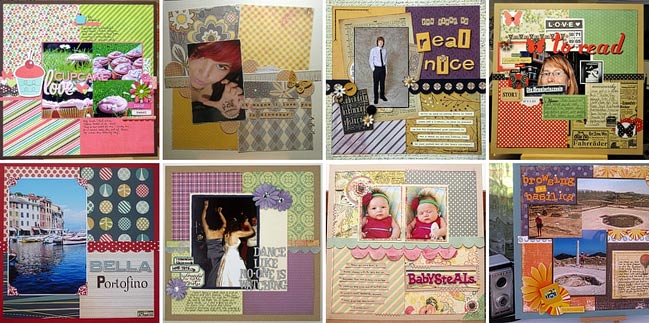
Top row, L to R: one, two, three, four. Bottom row, L to R: five, six, seven and eight. Click the corresponding link to see the layout in more detail and get to know the scrapper behind the page.

Here are eight of my favourites from last week’s starting point, but it was so very tough to choose from all the submissions! If you have more time, do check out even more pages from that same design.

I hope the rest of your weekend is lovely!

xlovesx

PS: There are two giveaways open at the moment! This one closes tonight and this one is open until Wednesday. Good luck!

American Crafts Scrapbooking Blog Hop

american crafts scrapbooking blog hop
Hello there hoppers – today we’re hopping through the American Crafts design team blogs and we have all been set the same challenge: make a layout with something from each of the new lines: Amy Tangerine, Daydreams, Garden Cafe, Nightfall and Hollyday!

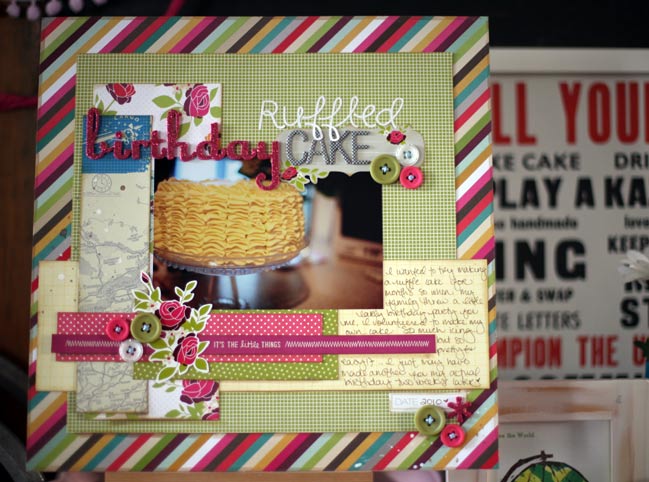
scrapbook page - american crafts Supplies include Sarah Script letter stickers in white (4133), Fancy glitter Thickers in strawberry (53111), Goodness Thickers in slate (53249), glitter edged buttons (85558), Elements buttons (85573), Savor Remarks stickers (42210), Rose’s Kitchen paper (35540), Joyful Day paper (35603), Fine Day paper (35606), Autumn Cider paper (35519), Yes Peas paper (35549), Wanderlust paper (35548), Cafe Iris paper (35541), all by American Crafts.

I love the birthday colour scheme that comes from a combination of the Amy and Garden papers, and the b-sides from Daydreams are the most versatile patterns ever – tiny stripes, polka dots and grids. Nightfall includes some very versatile cream patterns. Then I added stickers from Garden Cafe plus buttons from Daydreams and Hollyday. I love the glitter detail on the Christmas button pack. If you stopped by earlier today, you might see a resemblance – this is one example for this weekend’s scrapbook starting point. More striped-background wonderment!

There are plenty of chances to win American Crafts prizes throughout the blog hop today. Leave a comment on this post to enter the drawing for a pack of adorable Details embellishments. Hop through the designers’ blogs for additional chances to win then enter the big drawing at the AC Studio blog where someone will win two full collections of crafty goodness! Both the big AC giveaway and my giveaway are open until Wednesday the 21st of September 2011, 9am Pacific, which is 5pm here in the UK. If you don’t win, you can also shop for all the new AC lines here.

The next stop on the hop is Suzy – go there once you have entered the drawing here. I know she’ll take great care of you!

Thanks for stopping by!

xlovesx

Scrapbook starting points

scrapbook starting points
Oooh, hello there Saturday. You’re looking rather lovely indeed! And just because, I have a little twist for this week’s starting point.

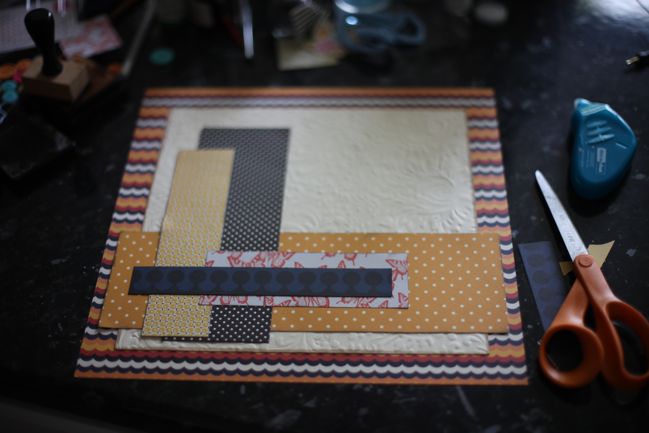
Recently I noticed I love striped papers when I’m shopping and I often use them in small pieces but I still have a sizeable stack of full sheets and I wondered if maybe I should use them as backgrounds more often. Trouble is, a full sheet of 12×2 stripes is quite a statement – either you can go with that or find something to give it a bit of balance – and lately I’m loving the idea of layering a 10×10 box of something more subtle over a boldly striped 12×12 background. So much so that I’ve actually made two layouts from the same starting point this week.

This first example includes papers from the Jenni Bowlin Studio Halloween collection, but the finished layout isn’t actually Halloween-themed. I’ll show you that finished version tomorrow with my favourites from last week’s starting point. (There is still time to add your link to that if you’re scrapping today!)

For those of you who prefer measurements, the only piece I really measured was the 10×10 box, but the others are roughly 4×11.5, 3.5×8, 2×7, 2×6 and 1×8 (all in inches). Is that helpful? (Let me know if you think I should always include the measurements with the starting point.)

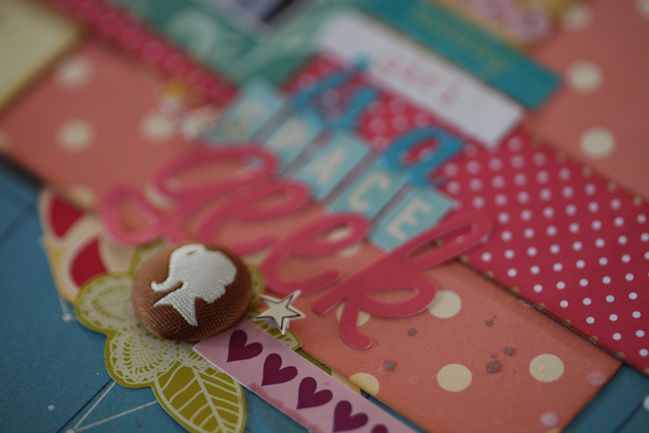
The second example is something a bit brighter in colour… and it’s part of a bit of Saturday fun from the American Crafts design team. That will kick off in mid-afternoon UK time, so I hope you’ll pop by to see what those girls have up all their sleeves!

I hope Saturday is looking lovely for you too – and maybe lovely for crafting!


Scrapbooking Challenge :: Not All Astronauts are Boys

scrapbooking challenge :: fill in the blanks
scrapbook page detail ©twopeasinabucket.com. Click here for supplies and details.

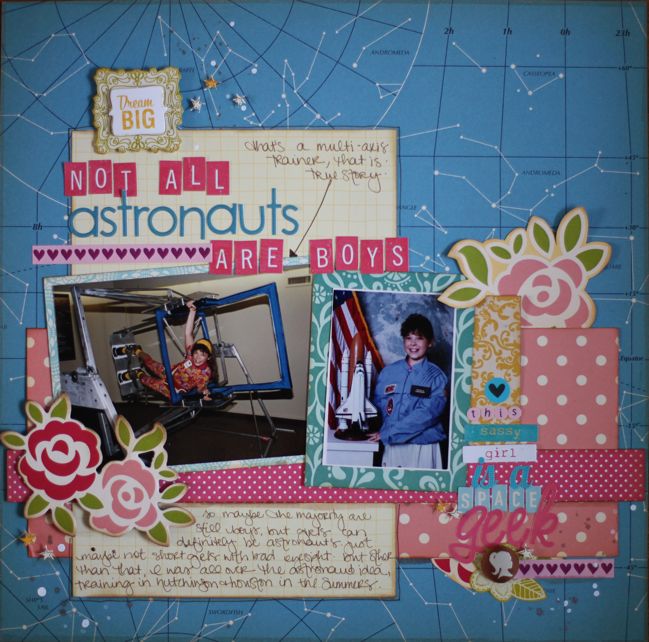
It’s my turn to host the weekly challenge at Two Peas, and I drew the journaling prompt card. It’s a fill-in-the-blank challenge and you can use it for your title or your writing on a scrapbook page. You have to fill in the blanks for Not all ——— are ——-. Like this:

scrapbook page ©twopeasinabucket.com. Click here for supplies and details.

Not all astronauts are boys, not all crafters are girls, not all somethings are something. That’s the idea – go against the expected, then tell the story behind the statement with photos and writing. The Tolkien line Not all who wander are lost would work too. Fill in the blanks with whatever would suit your story.

I’m really not a tomboy in any sense of the word and I don’t think I have have been… but while I love all things girly like pink and nail varnish and dresses, I also have a long-term love of maths and science and… space. So I loved the idea of Rocket Age from October Afternoon – an entirely space-themed collection done with a vintage kitsch twist. I thought it was amazing, until I heard people continually comment on how it was a BOY collection. Really? I mean look at that sheet of paper – it’s constellations on a lovely blue background. Is that really something that can the boys get to claim all for their own? I had to put this right (if only for myself) and balance that blue background with some pink polka dots, tiny hearts and chipboard flowers.

Click here to find the challenge at Two Peas including how to enter! I wonder how many ways you can fill in those blanks.

xlovesx

Giveaway day!

scrapbooking giveaway day
Prize Description
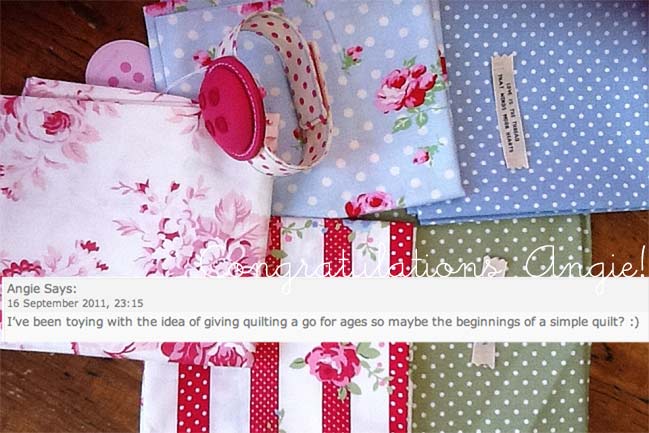
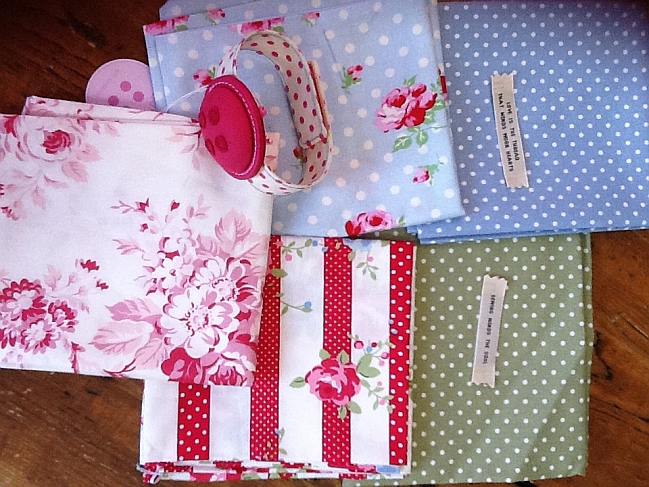
This weekend, one commenter will win a selection of fabric fat quarters, some cute labels and a gorgeous ‘button it’ wrist band pin cushion from Owl and Sewing Cat.

Owl and Sewing Cat is a pretty sewing shop situated in the seaside town of Eastbourne, East Sussex. The shop carries a range of contemporary ‘easy sew’ (and ultra-cute!) fabrics including designers such as Amy Butler, Michael Miller and Tanya Wheylan. Owner Tracey was excited to share her goals for the shop with us:

Hot on the heels of the latest trend of ‘make do and mend’ and the revival of the sewing machine, Owl and Sewing Cat is pleased to have opened its retail shop and the online shop is useful if you can’t get to Eastbourne!

Owl and Sewing Cat is also on a mission to get as many people as possible sewing, and is running sewing lessons for those wanting to learn, with simple kits available to have you making stunning bunting, bags and cushions in no time. It’s a great way to spend some time with family, friends or simply take some time for yourself.

You can read more about the shop on their blog or stay up to date via their facebook page.

To enter, just leave a comment on this post describing what you would make if you had a whole day to sit and sew.

Entries close at midnight Sunday UK time and the winner will be posted Monday evening, so be sure to check back to see if it’s your lucky day!

Good luck!

xlovesx

Camera School 04 :: Notes on Aperture (or that blurry thing)

camera school 04 :: notes on aperture and blur and stuff
Back in lesson two, I promised no triangles to explain exposure. That’s because memorising ISO gets rid of one point on the triangle (and if you read lesson two you’re remembering your rough settings of 100, 400 and 800, right?) and in this lesson, we’re going to eliminate another point on the triangle: aperture.

First, let’s get over the weirdness of the word aperture and how it applies. Cardmakers, you can come into your own here because aperture is part of cardmaking lingo too! An aperture card is a card with some sort of cut-out in the front, like a window (often a circle) that lets you see inside the card before you even open it. Well, on a camera the aperture is that window – in the lens. Aperture just means opening, and there has to be some sort of opening on the camera or how on earth would we ever take a picture? The real question is does your camera (or lens) allow you to adjust the aperture?

On an SLR, the answer is pretty much always yes. On a point and shoot, the answer used to be always no, but point and shoots (and bridge cameras) have made a great deal of progress lately so now the answer might just be yes. If you don’t know if your point and shoot gives you any aperture control, either look up aperture in your manual now or don’t even get up from your chair – just open a new window and type “Can I adjust the aperture on model of camera here“ into a search engine. The internet knows everything – someone out there will have posted your answer if it’s possible, and probably written a post with example images as part of a camera review! Oh internet, whatever did we do without you? If the answer for your point and shoot is no, then you can skip the shots at the end of this, but if you’re ever thinking of upgrading, this concept will prove quite useful.

Adjusting the aperture just means making that window bigger or smaller. Have you seen a very old photo – maybe of a house in a field – where everything seems to be in focus? Those were mostly taken with pinhole cameras, with the teeniest-tiniest of apertures. If you look through just a pinhole, everything you see is in focus. The reason those photos were often of buildings was because buildings didn’t move. See, if you’re only letting in just a pinhole’s worth of light, you need a fair bit of time to take the photo, otherwise the photo will be too dark. With people or anything else that moves, that just doesn’t work, but buildings are usually happy to stay put as long as you would like!
camera school :: shallow depth of field
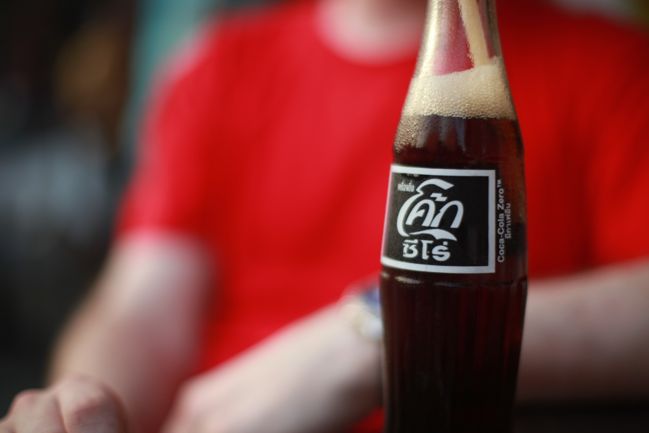
Sometimes it’s just not practical to sit there with your lens open for seconds or even longer. The moment will be gone, something will have moved or you will have lost your patience! So we adjust the aperture to let more light into the camera – we make the window bigger. But that means not everything will be in focus any more. It does, however, have a side effect – the bigger the window, the softer the blur in front and behind your point of focus. The example just above is from this post all about my love of that blur. The aperture on this shot was as wide as the lens would go. (In this case, 1.4 on a 50mm lens, for those who like those kind of details.)
camera school :: aperture
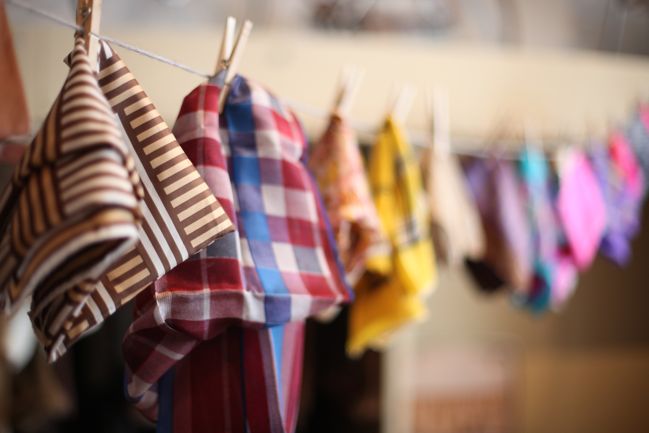
Just like ISO is made easier by remembering just a few rough points, aperture is exactly the same. Take this picture for example: it’s shot with a very wide aperture, which you’ll also see referred to as ‘shooting wide open’ or having the lens ‘wide open’. If I wanted to focus on just that particular handkerchief, then I’m all set. If I actually meant to make all of them visible, then I’ve failed miserably. The wider open the lens, the less of the scene will be in focus. Something small like a pinhole would get everything in focus (provided it didn’t move!) but that wide aperture makes it impossible to focus on everything.
camera school :: aperture for group shots
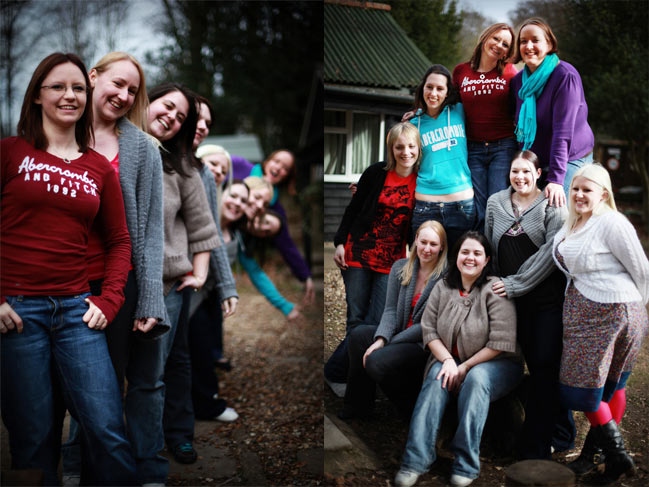
With handkerchiefs and flowers and cupcakes and assorted other objects, a bit in focus and the rest blurred is lovely. But there are times when it doesn’t work – namely with people. If you photograph a group of people, usually you want to see all of them. The shot on the left uses a wide aperture, so when photographing something with depth – like all these girls lined up toward the camera – most of the depth will be blurry and only a bit of the scene will be in focus. It’s an interesting look in this case but it doesn’t help you know all those faces at the back of the line.

There are two solutions to this: move the people or change the camera settings. The image on the right moved the people. Now they are mostly at the same depth, so I could get the girls in focus but the background is relatively soft.
camera school :: aperture for group shots
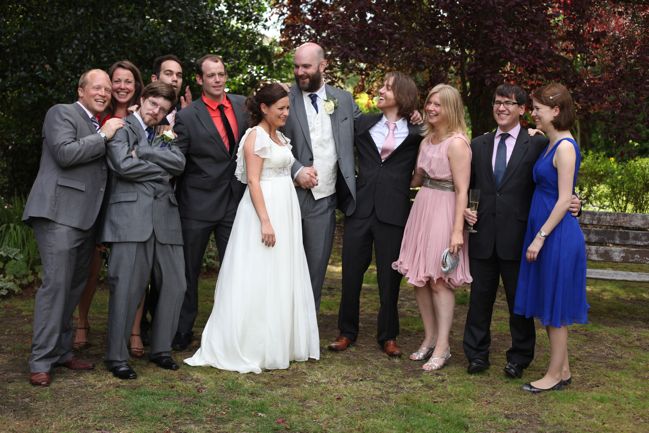
Or here’s the second solution: change the camera settings. While the two photos of the girls were shot at a very wide aperture (1.4), this little outtake with friends of the bride and groom was shot with something smaller (4.5). That makes more of the scene in focus.

I think the real reason why aperture can get confusing sometimes is its measurement in numbers. Numbers for ISO, numbers for aperture – it can look like a lot of maths going into a picture! And at some level there is but we don’t have to get that technical. If we can remember the 100-400-800 guideline for ISO, we can do the same for aperture. Hear me out.

If you have an SLR, look at your favourite lens. The full name of the lens tells you what apertures you have available. It’s usually painted right onto the lens itself, but you can also just look it up on the item description of any camera store site. So say you have a 50mm lens. If you’re a Canon user for example, the most popular options for the 50mm are this 50mm 1.8 and this 50mm 1.4. Those numbers at the end refer to the aperture. The 1.8 lens is much cheaper than the 1.4, and the aperture is a big part of that. (The 1.4 is also made with more expensive and more durable materials in both the lens housing and the glass itself, so the difference is more than just the aperture, just to be clear.) What you need to remember is the lower the number, the more it will blur. Or if it is easier for you, the smaller the number, the smaller the plane of focus. They mean the same thing, but I think one or the other usually sits a bit better so choose the one you like best!
camera school :: wide aperture, missed focus point
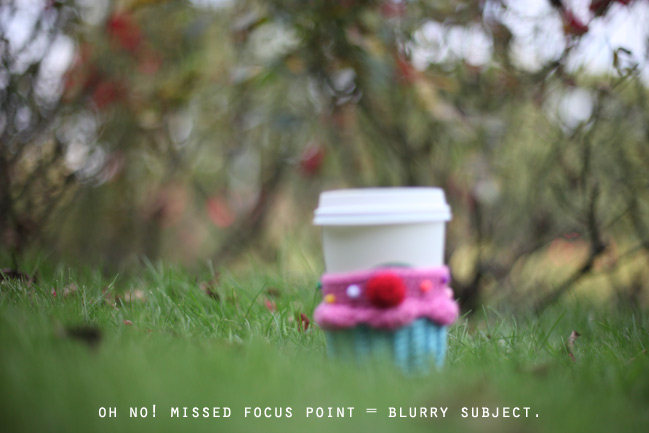
Either way, if you’re shooting at 1.4 or 1.8, you have to be careful where you focus because you’re only working with a small area that will be clear. I tried to focus this without looking through the viewfinder and the autofocus thought I wanted the grass rather than the coffee cup. Um, no… not what I wanted. With objects like this it’s easy to just refocus and shoot it again, but what if that were a toddler or a puppy? Yeah, not so much on getting that shot again, right?

Not all lenses go down to numbers that start with one. The 100mm macro goes (for ultra close-ups) to 2.8 and the 17-40mm (for crazily wide shots) goes to 4.0, but both of those lenses will blur a great deal at their lowest numbers. (Especially the 100mm – this is one of the first photos I took with the 100mm macro and it’s nearly all blur!) So you don’t need a really low number necessarily – but you need to know how low your lens can go. (Did you just say that like the limbo chant? I am really hoping you did.) Once you know how low it can go, you just need to remember that lowest number is going to have the most blur (or the smallest plane of focus – whichever you prefer).

If you can remember just that, then the rest is easy. Because if a low number gives you the most blur, what will the highest number give you? The most IN FOCUS. Or the least blur. Same thing. So really this is not complicated math – this is remembering one thing and that one thing will make the rest make sense.

Now let’s actually take some pictures to start to see this happening. Just like ISO, there are two options for this assignment. If you don’t know how to change the aperture on your camera, now is the time to learn! If you have an SLR, it’s probably easier than you think. You can put your camera in Aperture Priority mode (look for A or Av on your dial) and then you’ll be able to set the aperture but let the camera do the rest. You can use your camera manual or you can search for ‘how to set aperture’ or ‘aperture priority mode’ plus the model of your camera and there you will likely find pictures of your exact camera so it’s super-easy to follow. Basically you’re going to use one dial to set it to Aperture Priority then use the other dial to change the aperture to what you want – and the numbers will show up on your screen, but if that sounds problematic, there will be pictures of your exact camera in the manual or online so you can follow that.

Once you know how to change the aperture (or if you already knew that!) then find a scene with some depth – some things closer to the camera than others. Take two pictures – one at the lowest number you can dial to and one at the highest. I have to admit, this is the least original idea for a photography assignment, but this really is the easiest way to see just what your camera can do. Look at the two shots side by side and see just how much range your lens has. Give it a try and then come back tomorrow for something way more creative!

click here for more camera school posts

Scrapbooking Sketch of the Week

scrapbooking sketches and scrapbook page ideas
scrapbooking sketch and scrapbook page ideas
This morning I was flipping through some prints looking for something when I realised I had never printed it at all, because I had actually made a digital page about something. And it’s actually a digital page I like but I’m not completely sure how I’m going to work it in with the flow of that particular album, so I figured some other photos from the same day could live happily on paper. (And if you read my Facebook/Twitter post asking for title suggestions for this page, now you know why! I apologise for resisting all the adorable ‘deer’ puns.)

scrapbooking sketch
I know it’s a bit of a shock but this week I actually printed my photos at home. On my printer. Mostly because I was totally inspired by the Snapshot frames by Paislee Press. So this week’s sketch as a little something different for the photo element – a block of pictures that can be just one photo or you can fill it with as many pictures as you like in a space of about 5×7. I went with four photos, all landscape, printed with the frames.


In the video you can see my original rough for the sketch, which included scallops for the border at the side and the small punched border strips. If scallops are a better fit to your layout, then feel free to take inspiration from that version of the sketch.

As always, the weekly sketch is no-stress and just for fun! If you use it, I’d love to see, so please leave a link if you post your page online.

scrapbook page ideas
Here are four of my favourites from all the layouts shared last week. Love all those layers on so many pages! I think I’m going to take on a new motto of I have paper and I’m not afraid to use it. It can be a group motto, of course!

Click the corresponding link to see any of these layouts in more detail and get to know the scrappers behind the pages.
Top Row, L to R: one, two.
Bottom row, L to R: three and four.

Now… are you up for some sketchy scrapping this week? Will you use just one photo or add several photos to a block? Can’t wait to see your interpretation of this sketch!


(I’m trying a different linking widget lately. If you find it better or worse than the old option, could you let me know? I haven’t quite decided which option is the winner just yet. Thanks!)